Rembetika
Songs of Unspoken Sorrow
It may seem weird that some Turkish man writing about Rembetika.
But after years of interest, hundreds of hours spent on reading and thousands of drachmas spent on rempetika books and cassettes; I feel a humble authority to write something on this unique music phenomena.
On the other hand, being born in Mikra Asia is also a good reference
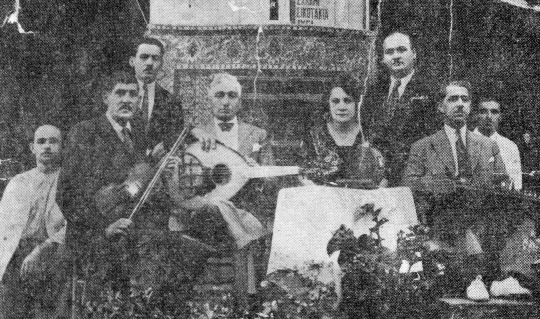
A Group of Rembetes
from 1925
Ematha Pos Eisai Magkas
Έμαθα πως είσαι μάγκας, είσαι και μερακλής,
πως γυρίζεις στις ταβέρνες, είσαι και μπελαλής
I heard that you're a "mangas", and also a "merakli",
you wander around "tavernas" and you're also a "belali".
This is an excerpt from one of my favorite rembetika songs. And it represents the very spirit of rembetika. There are four special words that belong to rembetika jargon
| mangas | Represents a bold, courageous person that likes to fight, take drugs and listen/play rembetika |
| merakli | It's a Turkish-origin word. In Turkish, it means "curious" person, but in Greek it refers somoene who likes to drink, smoke, use drugs and enjoy all life's pleasures. |
| taverna | Greek restaurant that ouzo is served and you can listen live music. |
| belali | Again a Turkish-origin word. Same as in Turkish, it means a bully person who loves to fight and challenge other people. |
Basics
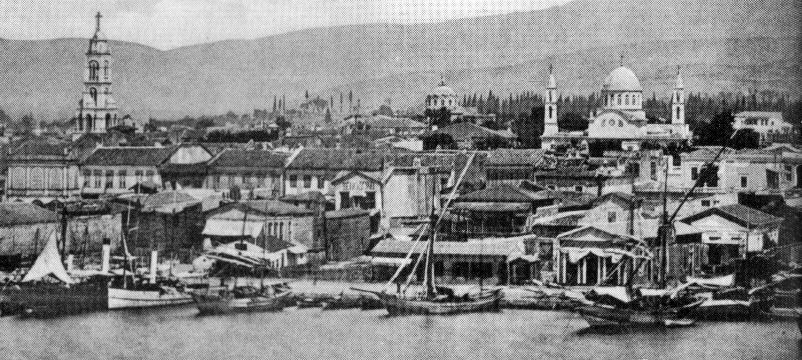
Izmir (Smyrna)
by the Beginning of the 20th Century
Rembetika is a music genre that was born at the beginning of 20th century in Greece and was very popular till the end of the 2nd World War.
This genre is well known for its mostly pessimistic lyrics and the sub-culture of in which it grew.
The rhythms and the style of Rembetika is mostly inspired by its roots in Mikra Asia. When observed generally, you see that the melodies are more alike to Anatolian style. But on the other hand, nearly all significant Rembetika songs are composed and sung only in Greece (mostly in Athens).
And this is just the point that makes Rembetika special. The people that created Rembetika were the immigrants who were forced to leave their homes in Anatolia (by the population exchange in 1922). They have never adapted themselves to their new country and they gradually formed a sub-culture in Athens and other large cities of Greece. Even today, immigrants from Turkey are not regarded as full blood Greeks.
We can feel their endless sorrow and pain from these wonderful Rembetika songs.
A Rembetika Song
ΣΑΝ ΘΑ ΠΕΘΑΝΩ
Σαν θα πεθάνω, βρε παιδία,
αντί κεριά, λιβάνια
βάλτε φωτιές μες στο λουλά(1)
πνίξτε με στα ντουμάνια.
Κι αντί για διάκο και παπά,
λαμπάδες και λουλούδια,
κόψτε σπαγγάνια τουμπεκία(2)
(βάλτε φώτιες στον αργιλέ)
και πέστε μου τραγούδια.
Και όταν θα με θάψετε
θα ήθελα ακόμα
τον αργιλέ στο πλάι μου
το τραβηχτώ στο στόμα.
Μπαγιαντέρας (Δημήτρης ΓΚόγκος)
WHEN I DIE
When I die, my friends,
instead of candles and incense
put some fire on loula(1)
and drown me with smoke.
And instead of deacon and priest, lamps and flowers, cut some tombeki(2) (give some fire to nargile) and sing songs to me.
And when you bury me I want you also put a nargile beside me so I can pull into my mouth.
Mpagianteras (Dimitrios Gogos)
These two terms are related to "nargile" - traditional device for smoking tobacco (aka. hookah).
loula(1) : The upper part of nargile
tombeki(2) : Special tobacco for nargile

Gallery