My Own Work
Though insignificant yet
Even the facial age estimation term is not isolated enough to make a research. Anyone who has some knowledge on scientific research knows that, today you can only make research in a ridiculously small and isolated field.
This reality is even harsher in pattern recognition.
While starting the research I made these decisions to draw my research boundaries:
- My algorithms will use still face images (photographs)
- I'll only deal with adult specimens (older than 16), because aging in children has completely different processes
- I'll not use 3D face models
- Facial texture, shape and facial feature info will be the major feature set
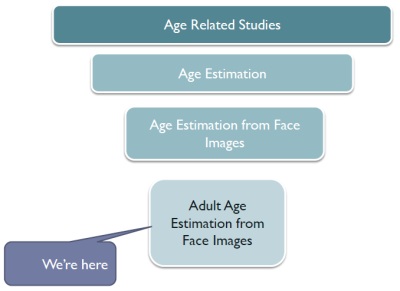
My Approach
My research interest location on the map
Methodology
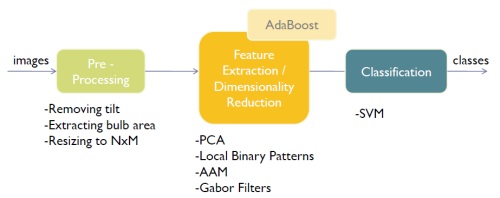
The methodology used
in three different fields
This is the starting point of my research. I know it's simple and it's not a new discovery.
For now, I'm in the process of repeating other people's works.
You cannot innovate new things unless you know the whole history.
The Very First Results
These are the first results of my algorithms.
This table compares the performances of PCA and LBP methods.
This is my first attempt by using my own Hollywood Database.
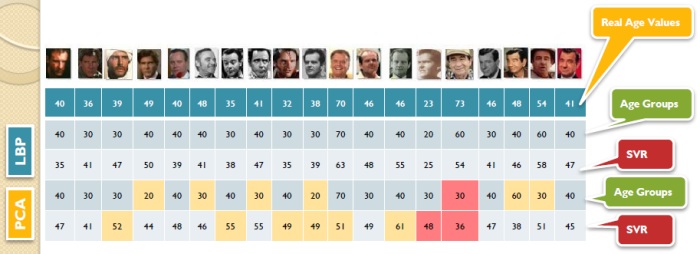
First results
of the algorithm
Reports
-
Effects of Aging over Facial Feature Analysis and Face Recognition
Report, September 2009 -
Face Recognition Across Ages
Report, April 2010 -
On Age Estimation by Using Still Face Images
Light Survey + Report, March 2011 -
Age Estimation from Still Images
Report, April 2011

LBP
Local Binary Patterns (LBP) is a type of feature used for classification in computer vision. LBP was first described in 1994. It has since been found to be a powerful feature for texture classification. Also it has proven that LBP yields great performance for face recognition.
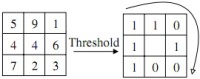
Rules are simple:
- Divide the examined window to cells (e.g. 16x16 pixels for each cell).
- For each pixel in a cell, compare the pixel to each of its 8 neighbors (on its left-top, left-middle, left-bottom, right-top, etc.). Follow the pixels along a circle, i.e. clockwise or counter-clockwise.
- Where the center pixel's value is greater than the neighbor, write "1". Otherwise, write "0". This gives an 8-digit binary number (which is usually converted to decimal for convenience).
- In the example above, binary representation is 110110011 and decimal representation is 211.
- Compute the histogram, over the cell, of the frequency of each "number" occurring (i.e., each combination of which pixels are smaller and which are greater than the center).
- Optionally normalize the histogram.
- Concatenate normalized histograms of all cells. This gives the feature vector for the window.